Not Enough Space to Upload. 124 Kb Needed.
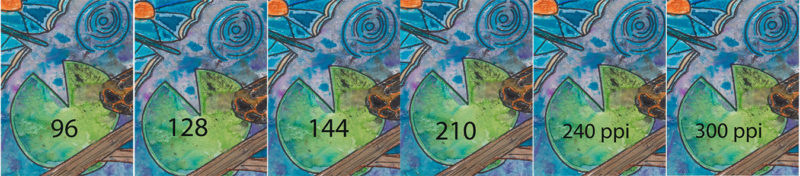
Resolution test strip. The original image portion used was 300 pixels per inch (31mp Hasselblad fine art capture). Each exam was downsampled from the original and printed on photograph newspaper at the same concrete size. In that location is some loss of quality between 300 and 144 ppi only barely perceptible. Beneath 144 we deem as well soft or blocky if you are walking upwardly to the prototype.
We are oftentimes asked what quality an image needs to be for printing. This is a great question, because sending a depression quality epitome will consequence in a disappointing, depression quality print. Prototype quality includes many factors of grade, from composition (the mode y'all set the image upwards if yous shot information technology), to colour choice, lighting, etc. These are actually important factors when capturing original artwork, and that's why we offering professional capture services. Buthere, we desire to discuss thesize andresolution of your images. Size isn't usually an issue if the paradigm is to exist printed in a memoir but a significant factor in a 60"x40" canvas. Let'south assume you lot've taken a fabled image, and are just looking to make sure it doesn't appear "blurry" or "blocky" when printed. How can you be sure it will print crisp and clear?
1 SIZE Does Not Fit All
Image size is the most important factor for big prints. In the most simple terms, is the image you lot are giving us to print big enough to fill up the space you want it printed on? If it is non, it will need to exist stretched or "blown up" somehow, and that ever results in quality loss.

The good news is, if you follow some basic guidelines, this should never be an upshot for you. Information technology can be very, very simple. We'd like to start with the uncomplicated, which will apply to most of y'all, then offering some more specific help for more than specific situations.
The Really Good News
Here is the really good news folks;
If you accept bought a digital camera in the past few years, and you accept taken your images at the highest quality setting of that camera, you images volition print just fine.
Too like shooting fish in a barrel right? Permit'southward expect a bit closer. Any photographic camera with a proficient lens, good sensor, etc, that is rated at5 megapixels or more than can requite a great 8 x 10 inch print, and even a decent quality 16 x 24 inch print. The xvi x 24 inch print won't look every bit good when you are standing 1 inch abroad from it, true. Simply at a comfortable viewing distance, information technology will exist just fine, even from a 5 megapixel epitome. Even today's cell phones offer cameras with v megapixel cameras! Merely make sure yous are taking the image at HIGH QUALITY setting on your camera. The file format ofTIFF is usually all-time for u.s., but we can also use high qualityJPEG orJPG images.
Hang onMegawhatsels?
Defining Some Terms
You got me – I said that you wouldn't demand to become complicated. And you're probably right. Let'south review that good news; "If yous have bought a digital camera in the past few years, and you have taken your images at the highest quality setting of that photographic camera, you images volition print just fine."
This is truthfulmost of the fourth dimension. But if you lot have a special situation, or just want to learn what's going on "backside the mantle", some basic understanding of terms doesn't hurt. Let'south get to the terms first, and if you adopt you tin skip to those "special situations" below.
Megapixels
What really matters for printing an paradigm is information technology's size. Digital images are measured non in inches, but inpixels. That is, the corporeality of private digital dots of color it takes to build the image on a screen. A xmegapixel image would have 10 million of those pixels (megapixel = million pixels). The manner you get at that tenmegapixel number is like to calculating the square footage of a room. Width x Meridian. So a 10megapixel image could be 5000 pixels wide past 2000 pixels loftier, for instance (5000 ten 2000 = ten 000 000 pixels). It could also be 3300 pixels wide and 3000 pixels high (3300 ten 3000 = 9,900,000 pixels – rounded up to 10megapixels).
Megapixels are of import, just not as of import as the electronics store salesman would have you believe. Why not? Because ownership the best available is not wise, unless yous need the best available. Buying what you need for your uses is what counts. Nosotros have seen images that had significant resolution merely were grainy and flat when printed at the size requested. In this case sensor size was an issue.
ALL cameras made today have more than enough megapixels for common press situations (and yes, that includes large canvas prints). You'll have a hard time today buying a new camera with also few megapixels for a decent size impress. Actually. 10megapixels is a common rating, with 18megapixelsand up becoming standard. Those are plenty large images folks.
Tip: When buying a new camera, don't focus on megapixels. In that location are enough. Focus on other factors that consequence the visual quality of the images y'all'll be taking, like the quality of the lens, performance in depression-light (if that matters to you), colour quality, paradigm stabilization, treatment, etc.
Pixel Dimensions
When we are asking for a certain size of epitome, we are request for information technology's pixel dimensions. That "3300 x 3000" number. When you provide usa with that number, nosotros can calculate how large the prototype can print at the settings we use on our printers hither at PageMaster.
If an image is larger than the minimum dimensions we need, there's no problem. If information technology is smaller, it however may be OK (if you cannot retake the epitome), but there may be some quality loss issues. If an paradigm needs to be re-sized, it's better that you let u.s. re-size it for y'all here than do it at home, as nosotros can exercise it quickly with the least quality loss and nosotros know the best settings for our print environment, such as the PPI we are looking for (minimum of 144 PPI, 240 OK, 300 all-time) at PageMaster.
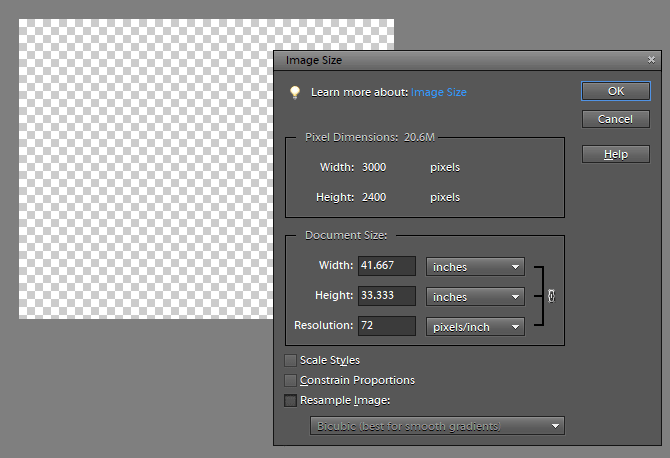
A 4000 x 3000 image from your camera is probably expressed at 72 ppi (standard monitor display resolution).
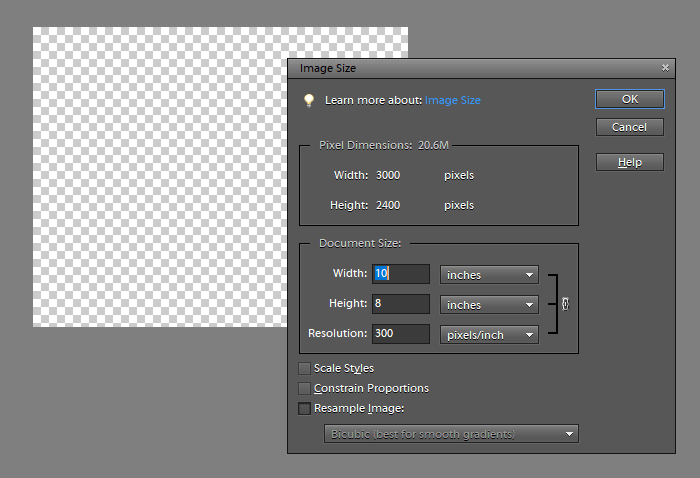
The same 4000 x 3000 prototype at 300 ppi is 10x13.three for impress. For wall viewing distances the prototype would exist about 21x28 at 144 ppi.
PPI/DPI
These ii terms,DPI (dots per inch) andPPI (pixels per inch) are often used interchangeably, but they are non the same thing. Nosotros'll usePPI hither, but know that some older programs may use DPI to define it's "resolution" for an prototype. We usePPI because it really tells united states nearly directlyhow many pixels will be printed on each inch of paper.Pixels per inch. It'south hownosotros decide the idealpixel dimensions needed to print your image on a certain paper or sail size. DPI is used to mensurate printer resolution and you demand many dots to faithfully reproduce a pixel.
An example may help. Let's say you desire to create an art card of your latest photograph. Allow's presume the card is going to be four inches past six inches. At PageMaster, we work with a minimum of240 pixels per inch (PPI) for these art cards. So, for every inch of printed space, we should accept 240 pixels of epitome data to get the all-time results. This requires simple multiplication. Let's beginning with the width of 6 inches. Multiply that by 240 and you lot get 1440. The image should exist 1440 pixels across. The superlative? iv inches x 240 PPI = 960 pixels. The image you provide united states should be at least 1440 pixels by 960 pixels for a 4 x six print. We know this because we desire an paradigm with a minimum resolution of 240 PPI.
So, what is the megapixel count of that image? Hold on to your seat … a whopping i.4 megapixels (1440 x 960 = 1382400 pixels = 1.4megapixels). Your cell telephone photographic camera can likely practise that folks. That's why nosotros didn't want you to sweat the details. It's not that the details don't matter, it'due south just that the details are most probable fine.
Let'southward try one more instance, at a largerimpress size of 11 X 17 inches.
11 ten 240 = 2640
17 ten 240 = 4080
Pixel dimensions required = 2640 x 4080 for an eleven ten 17 impress.
Megapixel count = x.seven
Again, near any camera sold today volition give you ten megapixel images.
Photokaboom offers some great calculators for doing just this sort of thing, which you can access hither. The site every bit a whole has many tips you lot may observe useful for digital photography.
Viewing Distance
You tin encounter that we are already needing some adequately large images for a 11 10 17 print, but all that actually means is that the print will look as articulate as the file itself when you put it right upwardly to your nose and stare. Of course, you don't do that. To take in the whole image, you sit back a bit. The larger y'all print the image, the farther abroad you lot will view it. Considering no one looks at xx x thirty inch canvas print from 1 inch away, yous tin go abroad with fifty-fifty smaller pixel dimensions in your file. It'southward true that information technology won't look perfect upwards close, just it can await surprisingly good from a comfortable viewing distance , even if your file isn't quite big enough. I once printed a three megapixel file on a 20 x xxx affiche and, hanging in my living room, information technology looked perfectly clear. Next fourth dimension y'all get for a walk, step upwardly really close to a billboard and witness the magic of viewing distance. Chances are that billboard will wait very blurry upward close. Driving past, of fibroid, it looks fine.
File Formats and Compression
A file format is the way your file is packaged to be read by computers. More just, it refers to the extension – the text after the dot – in your filename. And then "house.tiff" would exist aTIFF file. "business firm.jpg" would be aJPEG file (these can have the extension of either .jpg OR .jpeg). We useTIFF files internally and high qualityJPEG files when file size matters.
Image file sizes tin exist huge and in that location are two bones ways to reduce the size. Lossless and Lossy. Lossless methods reduce file size without irresolute the prototype quality. Lossy formats do reduce the image quality.
Each time you make a modify and save a JPG file you lot volition loose a scrap more than. The quality level you cull when saving and the number of changes are important. Yous tin can end up with an unusable epitome even with high resolution. Piece of work in a lossless format and utilise JPG for the final files when size matters.
TIFF and PNG formats utilise an algorithms and are lossless. Enabling compression in a TIFF file will generally reduce the size past one-half. From a chance perspective a damaged compressed file may unrecoverable whereas a damaged uncompressed TIFF file will have missing bands. LZW is our default.
High end digitalSLR cameras will take "RAW" format photos. These are cracking foryou lot, considering you can have finer command over the colors, sharpness, etc of the photo in a photo editing program that supportsRAW file formats. RAW file editors are generally nondestructive – your changes are rendered on export from the original with no quality losses. RAW files are non great for u.s.a. however, considering nosotros volition probable get the unedited version of the image, which may lack some enhancements y'all have made. If you exercise use a RAW editor, like Adobe Lightroom, Apple Aperture or ON1, please export your images as JPG if e-mailing or uploading, or TIFF if sending on a disc or USB stick, before sending them to us or other service provider.
Special Situations
You want something really big

Photographer Bruce Deacon and client with sail print at PageMaster. Bruce'southward piece of work is available on our store.
If yous desire to reproduce an image on a really big scale, let'due south talk. Our 12 color wide format printer can print 44" wide (we practise big sheet reproductions and art paper prints), but in that location is a limit to sizes that we can print. A simple light amplification by stimulated emission of radiation examination print is the best indication of if your image will handle the size. One time a size is determined, we will look at the ideal pixel dimensions for your file and may discuss factors like viewing altitude with you if needed.
You've cropped your epitome
This is the big "what if" that could very well invalidate that simple dominion nosotros mentioned off the summit. Allow'southward say you lot took an image of a beautiful Banff mount, simply there is a bear-safe garbage can merely on the right edge of the epitome. Photo editing software (and even many cameras) will allow yous tocropan paradigm, selecting just a portion of it and erasing the residuum. This is similar digitally trimming pieces of the file off.Considering you are cropping away some of the image, the image is going to get smaller. A 10megapixel image is only 10 megapixel image if you lot apply the whole matter. If you ingather abroad twenty% of that image, it is now an 8megapixel image. This will likely not crusade problems in nigh situations, so long as you lot start with a large file (pixel dimensions) and use virtually of the image in your final crop. If you crop one face out of a whole crowd, however, the image of that face alone may not be large plenty to impress at a decent quality.
Your epitome is from the cyberspace
If yous've got an image from the internet, and information technology is not made specifically to be printed, it volition likely print poorly at larger sizes. Without getting too technical, an image 1000 pixels wide and one thousand pixels high takes upwardly much more space on a screen than on a loftier-resolution paper impress. Respecting copyright and supporting creatives is important. Just similar you want your piece of work to be acknowledged and paid for (and so y'all tin can create more great work), treat others with the aforementioned respect.
Moststock photography websites provide loftier resolution images suited for printing, but images that accept been found elsewhere on the web are probable non practiced candidates for impress.
Your image was taken at a depression quality setting
You lot now know how to become the correct images from your camera going forrad, but what if yous have an older image that you took before you became such an image expert? Unfortunately, there is no way to make the epitome larger without losingsome quality. In that location are some bang-up tricks nosotros can effort, but if the epitome size is too small, we cannot guarantee a magic bullet solution. That existence said, information technology's still worth a try. Contact usa with your questions.
You are ownership a new camera. What should you lot be looking for?
Let united states repeat – you can virtually ignore themegapixel buzzword. It matters, but on most cameras sold today, yous're well covered with a number of 10 or even higher. What y'all should be looking at is how the photographic camera will perform in the situations y'all volition well-nigh oft be using it (lots of depression-light photos, for case?). What is the quality of the lens? How much zoom is provided (ignoredigital zoom – it really does cipher but crop your prototype in the camera, making information technology a smaller size paradigm)?
If you are going to be doing photography seriously, taking and printing a lot of images, and selling those images, we encourage you to go a Digital SLR (single lens reflex) photographic camera. The investment may be a bit higher, but the flexibility and paradigm quality (not epitomesize) more than makes up for the price difference. These are the big black cameras with lenses that spiral of and can be changed. These cameras piece of work much like the SLR cameras of the past, focusing on photography basics likeaperture, shutter speed,ISOlight sensitivity and more. These nuts are invaluable for you to learn, and you tin can get a lot of aid online (Google is your friend), or past taking a low-cost photography course in your urban center (hither in Edmonton, courses are offered by the Urban center Arts Middle, among other places).
More than Questions?
We're happy to help. Become in affect with us today and play "stump the printer"!
Source: https://pagemaster.ca/photo-resolution-sizes-for-printing/
0 Response to "Not Enough Space to Upload. 124 Kb Needed."
Post a Comment